The central auditory system
The central auditory system allows sound to be transmitted from
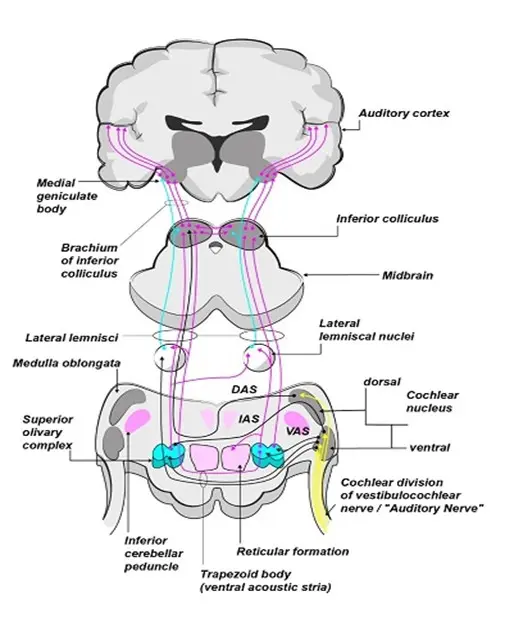
the first neurons of the auditory nerve to the brain. It is the system responsible for interpreting auditory information. The peripheral system communicates with central hearing through afferent nerve fibers, which pass from the organ of Corti to the auditory cortex, and efferent nerve fibers, which work in the opposite way. The cells of the organ of Corti are divided into outer hair and inner hair. These two types of cells are connected to nerve fibers that form two auditory nerves (paired nerve 8). Then the auditory nerve information is sent to the brain through several nuclei in the brainstem (cochlear nuclei, superior olivary nucleus, lateral lemniscus, inferior colliculus, etc.). These nuclei allow further processing of the auditory message.
In addition to transmitting audio information, auditory pathways also provide the brain with information about sound frequency, intensity, and sound location in space. In fact, our ears transmit the sound stimuli entered through the outer ear to the middle ear and then to the inner ear, and in the inner ear, mechanical waves are converted into electrical waves. The stimulation of nerve fibers creates neural codes that the brain can decode, process and understand, and as a result sounds are heard.
Anatomy and physiology of the vestibular system
Recognition of movement and sense of position in space are carried out by vestibular receptors. Vestibular receptors convert the information related to the direction and speed of movement as well as the position of the body into electrical current and send it to the brain. The information sent to the brain is combined with visual, positional and movement information from the cerebellum and cerebral cortex, and as a result, controls gaze, body posture, automatic reflexes, and spatial orientation, which is mostly done on a non-conscious level. become It should be noted that movement is perceived, but there is no primary vestibular cortex, and the part of the cortex that does this work also receives information from other senses, including vision and visual perception. In fact, in daily life, the vestibular system, in addition to constantly understanding and identifying the position of our body in space in relation to gravity, also recognizes rotational and linear movements and provides appropriate responses to them.
Therefore, in the vestibular system, there are receptors for the sense of gravity and other linear accelerations, as well as receptors for angular accelerations, and in addition, it regulates the tonicity of the body muscles by sending nerve messages. The vestibular system works based on the balance between the left and right ears.
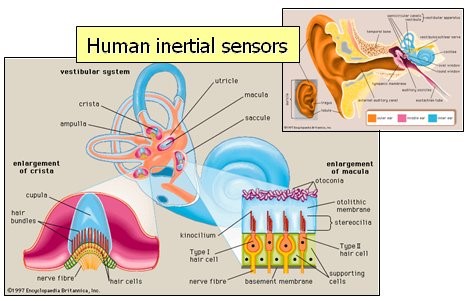
The vestibular nerve continuously sends signals to the brain that this rate of sending signals while resting (resting potential) causes the recognition of the state of the body, and during the movement and activity of the body, the increase of nerve signals to the brain and their processing leads to the understanding of the new state. and the brain issues the necessary commands to the muscles and organs of the body according to the received signals and combining them with the information of other senses. The vestibular system has 5 sensory receptors, which are: 3 sensory receptors in the horizontal, vertical and posterior semicircular canals that respond to rotational movements in 3 spatial axes.
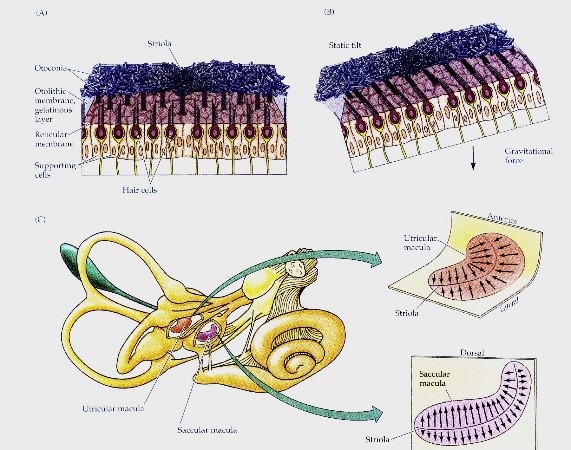
Also, 2 otolith organs in saccule and utricle which respond to linear movements in vertical and horizontal directions. The vertical canals and saccule are located in the vertical axis and the horizontal canal and utricle are located in the horizontal axis of the head. These organs establish neural connections in the brain with the oculomotor system (movement of the eyes) and position control. In addition to sensory receptors, there is also fluid in the vestibular system, which moves the fluid to transfer pressure and cause stimulation in the sensory receptors. As a result, mechanical energy is converted into electrical energy which stimulates the nerve fibers and finally receives electrical information in the brain and processes and integrates them with information from other senses to establish balance.