
Auditory rehabilitation is a broad field of science that deals with providing the ability or rehabilitation of listening skills. For children who have hearing loss since birth, the word “Habilitation” is more suitable for hearing rehabilitation services than the word “Rehabilitation” because these children do not have listening skills from the beginning and these skills must be taught to them. But in children or in adults who have acquired listening skills and then suffer hearing loss, so their listening skills should be renewed, which is called “rehabilitation”.
Special services for children depend on their individual needs, which are determined based on the child’s current age, age of onset of hearing loss, age of diagnosis of hearing loss, severity of hearing loss, type of hearing loss, extent of hearing loss and age of receiving amplification. We often know that the first disabling consequence of hearing loss in childhood is impaired speech and language learning. Research has shown that early detection and early use of auditory reinforcement and education have tremendous effects on the language learning abilities of hearing-impaired children. Research has also shown that the diagnosis of hearing loss in infancy or up to 6 months of age and the use of reinforcement and rehabilitation measures will bring the development of listening and language skills in line with their hearing peers.
Hearing rehabilitation services for children typically include:

1) Awareness of sound and identification of sounds (Auditory Detection)
Sound awareness is one of the skills that children must learn first to acquire speech. Sound awareness skills can be increased through exercises. Children learn a lot about sound and speech sounds before they understand the meaning of words. In order to improve the sound awareness skill, listening games can be used, which increases the child’s awareness of speech sounds, and the first words through listening and responding in an appropriate way. Therefore, make interesting sounds for your child and try to change your voice while talking to make it more interesting and exaggerate smileys for him and try to use all his senses (sight, touch, hearing). All children learn to sing simple songs over and over again by repetition. This helps to increase awareness of sound and speech rhythm. Use symbolic sounds for this. Symbolic sounds are the sounds of objects that are used in a meaningful way, such as the sound of a car moving, or the sound of animals. These sounds are usually repetitive and can be practiced over and over again. such as the sounds of bib, bib (car), baboo baboo (ambulance), hoohoo chichi (train) or the sounds of hop hop (dog), quack quack (duck), ba ba (sheep)
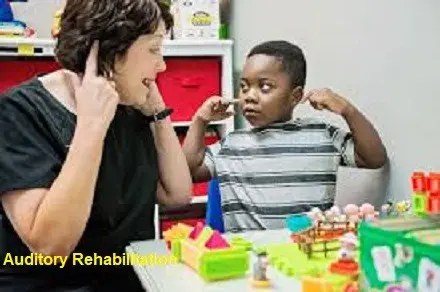
2) Recognizing the difference between sounds (Auditory Discrimination)
The stage of distinguishing sounds refers to the stage where a person differentiates between the sounds he hears. Differentiating between the sounds created by using sound instruments or sound sources is in the form of differentiating between two sounds and ultimately makes the child acquire the skill of understanding the combination of sounds. In the beginning, speech differentiation is done in the form of differentiating between dissimilar sounds and a number of meaningful phrases, and following the child’s progress, continuous exercises lead to accurate recognition of the differences in speech sounds and recognition of a large number of words by listening. Therefore, in the stage of learning to distinguish sounds from each other, you can first use the distinction of environmental sounds, and then distinguish the sounds of animals, and in the next step, distinguish environmental sounds from animal sounds and also distinguish environmental sounds from speech sounds. In addition, differentiating between strong and weak sounds, differentiating pitch and differentiating the rhythm of the song through clapping along with the rhythm of the song are among other exercises that should be used at this stage.
3) Linking meaning to sounds (Identification)
The stage of creating a connection between sounds and their meanings, which is referred to as identification, consists of correctly distinguishing sounds from each other in such a way that a person understands each one completely. The difference between this stage and the differentiation stage is that during the differentiation of sounds, a person should only be able to distinguish between similar and different sounds, but during the identification stage, in addition to differentiating between sounds, a person should understand each of them separately and What he heard by repeating or referring to it.
The stage of identifying sounds is more complicated than the previous stages, and all the previous stages must be completed at the time of this stage.
4) Comprehension
The final goal of hearing comprehension is actually understanding the stimulus, its meaning and concept. In other words, the ultimate goal is to determine what the purpose of the created sound was, especially in speech sounds. During this stage, one has to put a set of words together and get a general understanding of them. In fact, it should be said that understanding occurs when a person goes through all the previous steps and gets the correct interpretation of the message based on sound patterns.